|
Ziyun (Claude) Wang I am an Assistant Professor in the Department of Electrical and Computer Engineering at Johns Hopkins University, where I lead the SPIKE Lab. My research sits at the intersection of computer vision, robotics, and neuromorphic computing, with a focus on event-based, continuous-time perception—building systems that see and act at the speed of the physical world. I received my Ph.D. from the GRASP Laboratory at the University of Pennsylvania, where I was advised by Kostas Daniilidis. |

|
 SPIKE Lab
Join the LabI am currently recruiting Ph.D. students for Fall 2027. If you're interested in neuromorphic and event-based vision, 3D perception, or embodied AI and robotics, please email me at claude.w@jhu.edu with the subject line:
Please include your CV, transcript (unofficial is fine), and a short statement of interest or description of your research background. |
ResearchNeuromorphic and Event‑Based VisionPerception with brain-inspired event cameras: microsecond latency, high dynamic range, low power. 3D PerceptionRecovering the 3D structure and motion of scenes, objects, and people. Embodied AI and RoboticsClosing the loop from fast sensing to action in dynamic, real-world environments. |
News & Updates
Show older news
|
Publications* Equal contribution |
|
TRACE: Ergodic Trajectory Optimization for Active Scene Reconstruction
arXiv preprint, 2026
The first trajectory-level ergodic formulation for active Gaussian scene reconstruction. Footprint-aware ergodic search gains +1.5 dB PSNR over baselines and runs directly on real robots, including the Unitree GO2 and Franka FR3. |
|
|
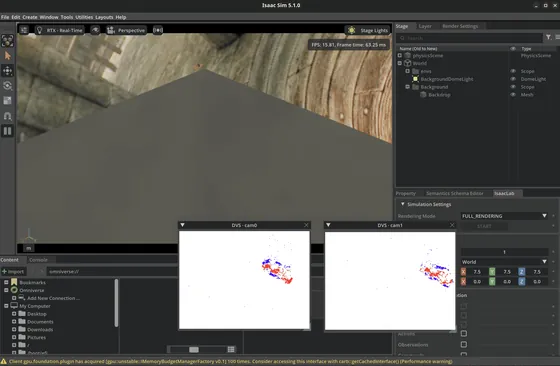
EVIS: A Physics-Grounded Event Camera Plugin for NVIDIA Isaac Sim
Open-source software, 2026
High-rate event camera simulation accelerated by motion-vector frame interpolation, with HDR support, sensor noise models, motion blur, and tools for downstream training. |
|
Match-Any-Events: Zero-Shot Motion-Robust Feature Matching Across Wide Baselines for Event Cameras
European Conference on Computer Vision (ECCV), 2026
Zero-shot wide-baseline feature matching for event cameras, using motion-robust multi-timescale attention and sparsity-aware token selection. Improves on prior event matching methods by 37.7%. |
|
|
Continuous-Time Human Motion Field from Events
International Conference on Computer Vision (ICCV), 2025
Human motion as a continuous-time field from events. A recurrent, time-implicit network supports parallel pose queries at any temporal resolution, with 23.8% lower joint error and 69% less compute. |
|
|
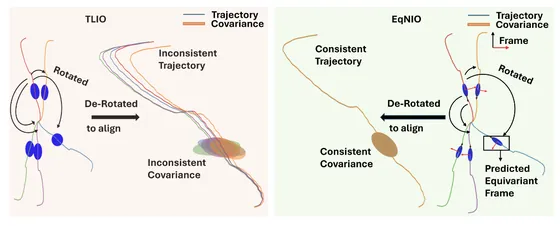
EqNIO: Subequivariant Neural Inertial Odometry
International Conference on Learning Representations (ICLR), 2025
Neural inertial odometry that exploits roto-reflective symmetries in IMU data through equivariant, gravity-aligned canonicalization, improving displacement estimates on the TLIO, Aria, RIDI, and OxIOD benchmarks. |
|
Event-based Continuous Color Video Decompression from Single Frames
Event-based Vision Workshop, CVPR 2025
Continuous color video reconstructed from a single RGB frame and an event stream, combining long-range motion modeling with neural synthesis to outperform baselines by 3.61 dB PSNR. |
|
|
Un-EVIMO: Unsupervised Event-based Independent Motion Segmentation
European Conference on Computer Vision (ECCV), 2024
Unsupervised event-based independent motion segmentation that uses geometric constraints to generate pseudo-labels, handles any number of moving objects, and is competitive with supervised methods on EVIMO. |
|
|
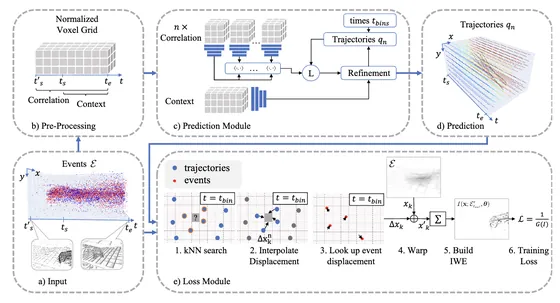
Motion-prior Contrast Maximization for Dense Continuous-Time Motion Estimation
European Conference on Computer Vision (ECCV), 2024
Self-supervised dense continuous-time motion estimation for event cameras, combining contrast maximization with non-linear motion priors to improve zero-shot real-world performance by 29% on EVIMO2. |
|
TRAM: Global Trajectory and Motion of 3D Humans from in-the-wild Videos
European Conference on Computer Vision (ECCV), 2024
Global trajectory and body motion of 3D humans from in-the-wild videos, combining robustified SLAM for camera motion with a video transformer for kinematic body regression. |
|
|
Track Everything Everywhere Fast and Robustly
European Conference on Computer Vision (ECCV), 2024
Test-time optimization for dense video point tracking with an invertible deformation network and foundation-model priors, over 10× faster and more robust than OmniMotion. |
|
|
M3ED: Multi-Robot, Multi-Sensor, Multi-Environment Event Dataset
Event-based Vision Workshop, CVPR 2023
An event camera dataset spanning ground vehicles, legged robots, and aerial platforms in challenging conditions, with synchronized stereo event cameras, LiDAR, IMU, and RTK. |
|
|
EvAC3D: From Event-Based Apparent Contours to 3D Models via Continuous Visual Hulls
European Conference on Computer Vision (ECCV), 2022 · Oral Presentation (top 2.7% of papers)
3D reconstruction from event cameras via continuous visual hulls built from apparent contour events, producing high-fidelity meshes from real event sequences with per-event refinement. |
|
|
EV-Catcher: High-Speed Object Catching Using Low-Latency Event-Based Neural Networks
IEEE Robotics and Automation Letters (RA-L), 2022
High-speed object catching with low-latency event-based neural networks and a binary event history image representation, reaching an 81% catch rate on balls at up to 13 m/s. |
|
|
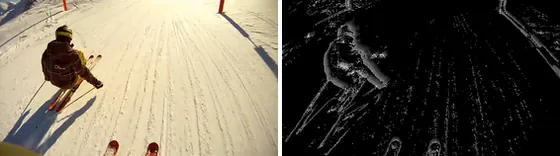
EventGAN: Leveraging Large Scale Image Datasets for Event Cameras
IEEE International Conference on Computational Photography (ICCP), 2021
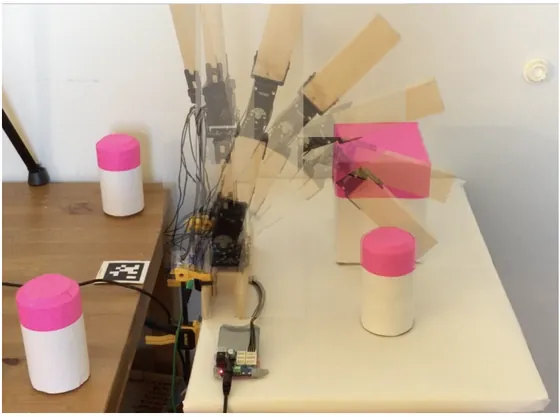
GAN-based event simulation from image pairs with cycle-consistency losses, enabling object detection and pose estimation networks to train on large image datasets without real event labels. |
|
Learning to Generate Cost-to-Go Functions for Efficient Motion Planning
Experimental Robotics: The 17th International Symposium, 2021
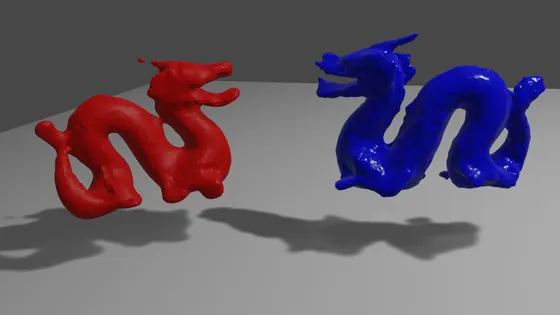
A higher-order function network that generates cost-to-go functions over configuration space, running orders of magnitude faster than planners that explore configuration space online. |
|
Surface HOF: Surface Reconstruction from a Single Image Using Higher Order Function Networks
IEEE International Conference on Image Processing (ICIP), 2020
Single-image surface reconstruction with a higher-order function network that maps unit-sphere samples to local tangent planes, generating surfaces at arbitrary resolution with few parameters. |
|
Geodesic-HOF: 3D Reconstruction Without Cutting Corners
AAAI Conference on Artificial Intelligence, 2021
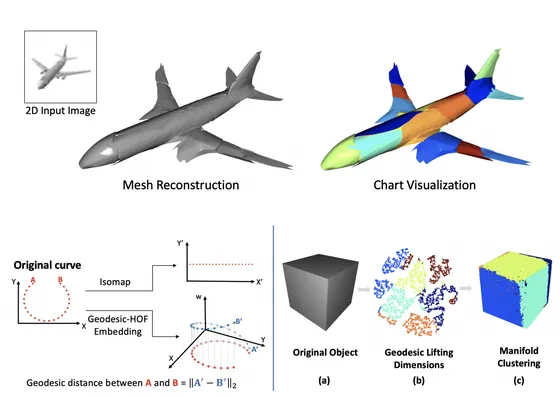
Single-view 3D reconstruction that lifts points into an embedding where Euclidean distance equals geodesic distance on the surface, improving surface normals and enabling unsupervised object decomposition. |
|
Motion Equivariant Networks for Event Cameras with the Temporal Normalization Transform
arXiv preprint, 2019
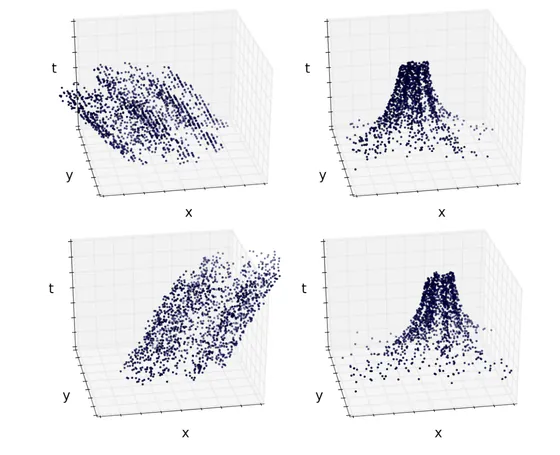
A temporal normalization transform for event data that makes spatiotemporal convolutions equivariant to optical flow, removing the need for motion augmentation in classification. |
|
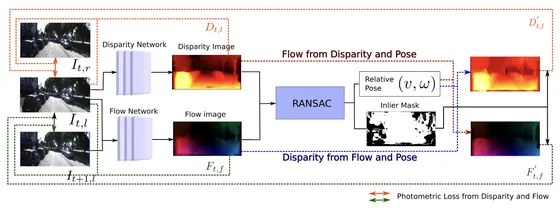
Robustness Meets Deep Learning: An End-to-End Hybrid Pipeline for Unsupervised Learning of Egomotion
Workshop on Deep Learning for Semantic Visual Navigation, CVPR 2019
A hybrid unsupervised egomotion pipeline combining learned optical flow and disparity with RANSAC outlier rejection and least-squares pose estimation, with automatic moving-object segmentation on KITTI. |